For advertisers
 For affiliates
 Marketing Tools
 Fraud prevention
 Automatization
 Lead generation
 Payouts
 Support
CTV Ads for Affiliates: Setting Up a Campaign
In the first part of our CTV series, we explored why Connected TV is becoming an interesting traffic source for affiliates and how platforms like Vibe.co make streaming TV advertising more accessible.
But understanding the channel is only the first step. The real challenge is turning TV ad views into leads, calls, and conversions.
How do you structure a CTV campaign? Which audiences should you target? What should your creatives look like, and how do you bring viewers back after they've seen your ad?
In this article, we'll break down the key elements of a CTV campaign and learn the difference between prospecting and retargeting campaigns. We'll also look at how to create a clear path from the first ad impression to the final conversion.
How affiliates can structure a CTV campaign
The biggest mistake is treating CTV like Facebook.
With social traffic, the user can click immediately. With CTV, the path is different. The user sees the ad on a TV screen, then may visit a website, search the brand, scan a QR code, or call later.
That means your funnel must be built around recall and simple action.
A basic CTV affiliate funnel can look like this:
CTV ad → landing page / QR code / vanity URL / phone number → lead form or call → tracking → payout
For pay-per-call, the ad should push one clear action: call now, check eligibility, compare options, request help, or speak with a licensed/specialist agent depending on the vertical and compliance rules.
For CPL, the ad can send users to a landing page with a short form. The page must be mobile-friendly because many viewers will open it from their phone after seeing the ad.
For retargeting, you can use CTV to reach users who already visited your site, clicked your ads, opened your email, or interacted with your funnel but did not convert.
Prospecting vs retargeting: start with both
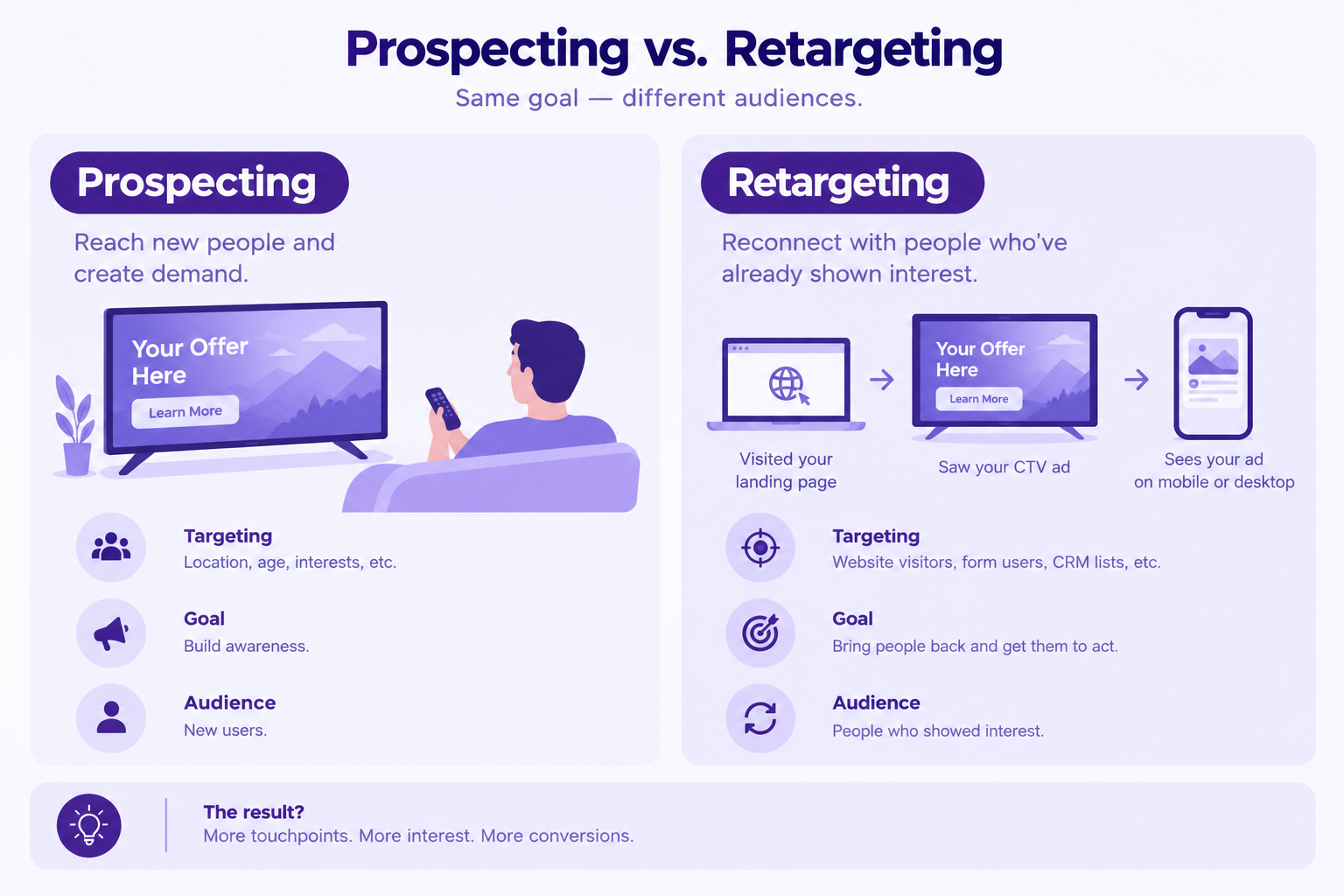
CTV can work at different stages of the funnel: prospecting and retargeting.
1. Prospecting campaign
Use broad but relevant targeting to reach new audiences. Depending on the platform, this could include location, age, household characteristics, interests, language, or income range.
The goal is to introduce the offer, build awareness, and create demand among people who haven't interacted with your campaign yet.
2. Retargeting campaign
Retargeting lets you reconnect with people who have already shown interest in your offer. This can include website visitors, landing page visitors, people who started but didn't complete a form, or audiences built from your CRM data.
But how does this work with Connected TV?
CTV platforms can use tracking pixels, IP addresses, and device-matching technology to connect website activity with streaming TV households. For example, someone might visit your landing page on their laptop, then later see your ad on a smart TV connected to the same household network.
The reverse is also possible. Someone who sees your CTV ad may later be shown a follow-up ad on their smartphone or computer. Platforms can use household IP matching and other identity signals to associate devices and make this cross-device advertising possible.
It's important to understand that this doesn't necessarily mean the platform identifies the same individual across devices. In many cases, the match is made at the household level, so another person in the household may see the follow-up ad. Matching also isn't guaranteed, and the available options depend on the platform, campaign setup, and privacy requirements.
Ad creative: keep it simple, human, and direct
CTV ads do not need to look like a Hollywood commercial. In many performance verticals, a simple, clear message can work better than an overproduced ad.
The best structure is usually:
- Start with the problem.
- Show who the offer is for.
- Explain the benefit.
- Add a simple call to action.
For example, in final expense:
“Funeral costs can put pressure on your family. If you’re between 50 and 85, you may qualify for coverage with no medical exam. Call now to check your options.”

This one and its variations you can test on our Final Expense Bundle intended specifically for CTV traffic.
For debt settlement:
“Struggling with credit card debt? You may have options to reduce what you owe. Call today and speak with a debt specialist.”
For home services:
“Roof damage after a storm? Local contractors are available in your area. Call now to request a quote.”
The ad should not overload the viewer with details. CTV is about clarity and memory. One message, one offer, one action.
Also, the CTA must be extremely visible. Use a short URL, QR code, and/or phone number. If the offer is call-based, the phone number should stay on screen long enough for the viewer to react.
How to use Vibe’s creative tools
One of the useful things about Vibe is that it lowers the creative barrier. Affiliates who already have UGC videos, social ads, landing pages, or brand assets can repurpose them into TV-ready ads.
This matters because many affiliates do not have a full video production team. You can start with a simple spokesperson-style video, animated explainer, or repurposed social creative, then test variations.
For example, you can test:
- Male vs female spokesperson
- English vs Spanish creative
- Problem-based hook vs benefit-based hook
- Phone CTA vs QR code CTA
- Short 15-second ad vs 30-second ad
- Localized creative by state or city
- Different angles for the same offer
The goal is not to make one “perfect” ad. The goal is to create enough variations to find the angle that drives measurable response.
Final thoughts
CTV isn't just about putting your ad on a big screen. It's about building a journey that takes viewers from discovering your offer to taking action.
Start with an offer that's easy to understand, define your target audience, and create a clear message with a simple next step. Then test your creatives, track the results, and use retargeting to reconnect with people who have already shown interest.
You don't need to build a complicated funnel from day one. Start with a focused test, learn how your audience responds, and optimize based on the data.
Want to put these ideas into practice? Final Expense is one of the verticals worth testing with CTV. If you're ready to give it a try, check out our offer below:
Test CTV traffic with our Final Expense offer
In the next part of our CTV series, we'll take a closer look at ad creatives: what makes a streaming TV ad effective, how long it should be, and how to get viewers to take action.