For advertisers
 For affiliates
 Marketing Tools
 Fraud prevention
 Automatization
 Lead generation
 Payouts
 Support
CTV Ads for Affiliates with Vibe.co: A New Performance Channel Worth Testing

For a long time, TV advertising felt like something only big brands could afford. You needed a media agency, large budgets, long planning cycles, and a production team just to get started.
CTV changed that.
Connected TV advertising lets performance marketers show video ads on streaming TV apps and channels — the same environment where users watch shows, live sports, movies, news, and entertainment content. And platforms like Vibe.co are making this channel much more accessible for affiliates who are used to running traffic on Facebook, Google, YouTube, native, or TikTok.
The question is no longer “Can affiliates run TV ads?”
The real question is: “Can affiliates make CTV work as a performance channel?”

The answer is yes — but only if you approach it the right way.
What is Vibe.co?
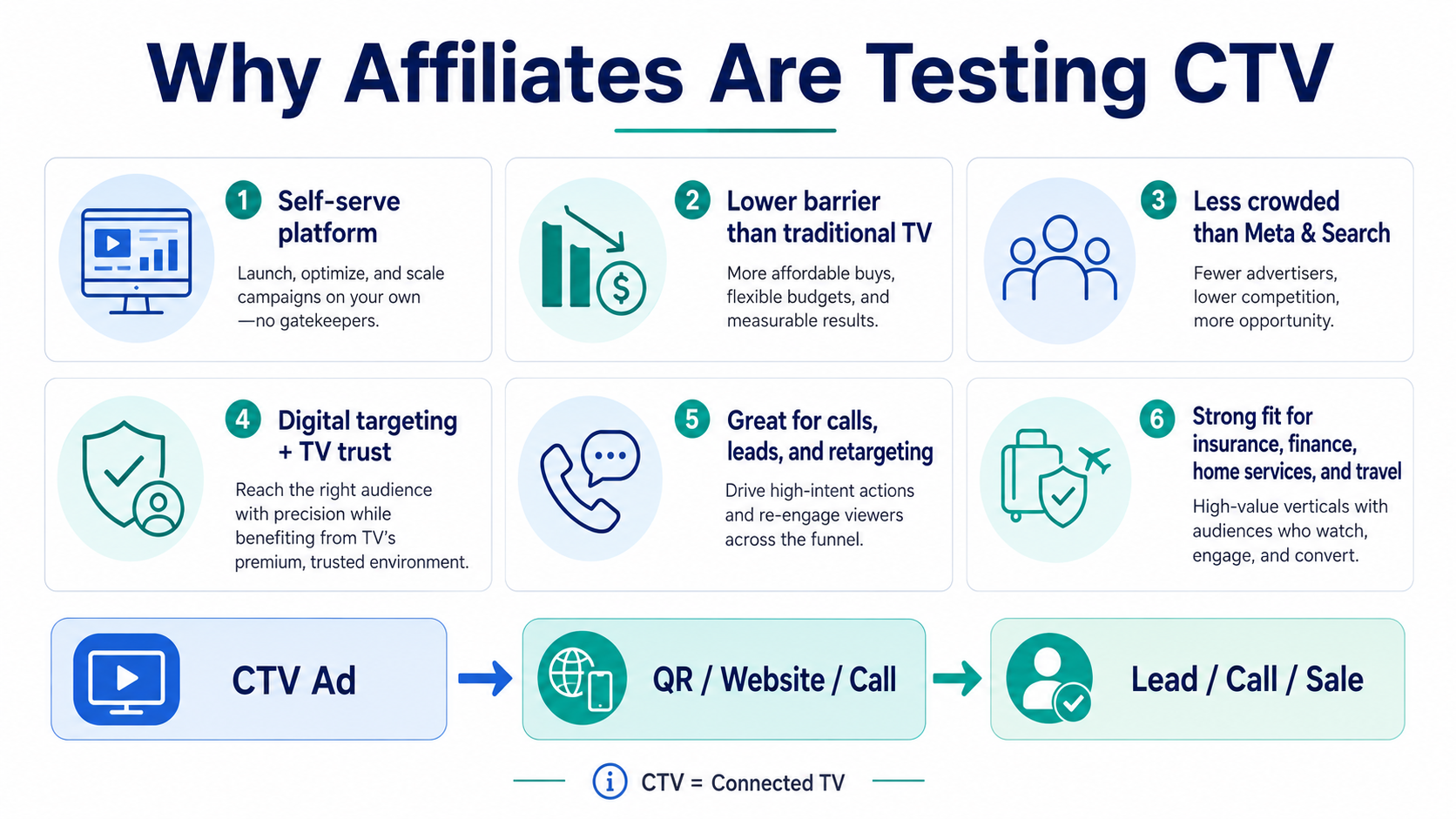
Vibe.co is a self-serve streaming TV advertising platform. In simple words, it gives advertisers and media buyers access to CTV inventory without the traditional barriers of TV advertising.
Instead of going through a big agency or negotiating direct TV buys, you can launch campaigns through the platform, choose targeting, upload or generate creatives, control your budget, and track performance.
For affiliates, this is important because CTV is not just a branding channel anymore. It can be used for measurable outcomes: website visits, leads, calls, app installs, sales, retargeting, and full-funnel campaigns.
Vibe’s own case studies show brands and agencies using CTV for ROAS, lead generation, customer acquisition, retargeting, and web traffic growth. That is exactly where affiliates should pay attention.
Why CTV is interesting for affiliates right now
Most affiliates are already familiar with the problem: traffic sources get crowded.
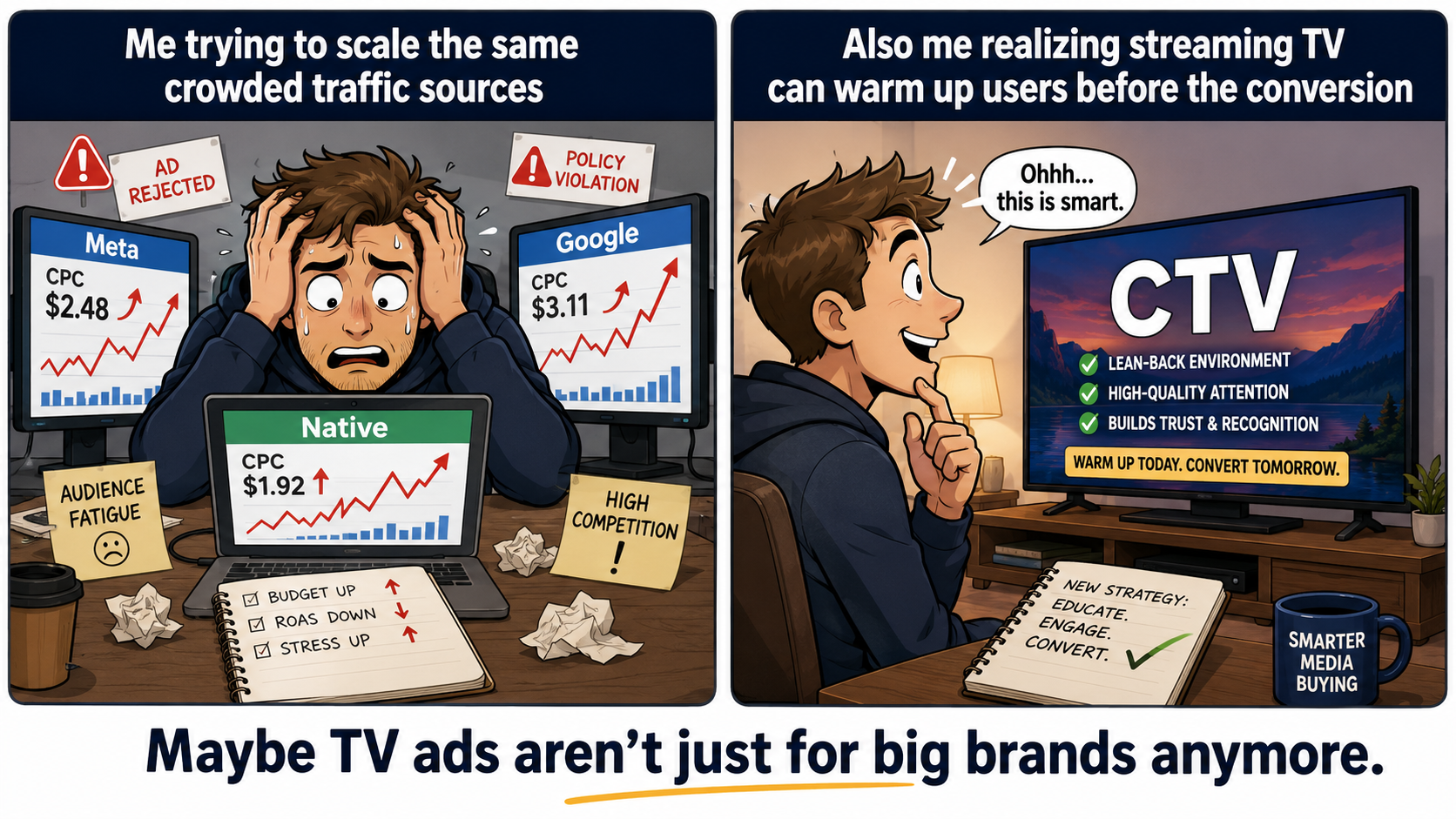
Meta gets more expensive. Google has stricter rules. Native quality can be unstable. Compliance-heavy verticals are harder to run. Some campaigns get rejected, accounts get limited, and costs keep changing.
CTV gives affiliates another angle.
It is not a replacement for search or social. It is a way to diversify your traffic mix and reach users in a less saturated environment. Instead of competing only in the feed or on search results, you appear on the big screen at home.
That changes the perception of the offer.
A user who sees an ad on TV may treat it as more trustworthy than another random banner or social ad. This can be especially useful in verticals where trust matters: insurance, debt relief, home services, healthcare, legal, finance, education, and high-consideration products.
For affiliates working with call-based offers, CTV can also create demand before the user searches or calls. In other words, it can warm up the audience before the conversion happens.
What types of offers can work with CTV?
CTV is usually not the best channel for impulse-click offers where users need to convert instantly after seeing a short ad. Remember: the user is watching TV, not scrolling with a mouse in hand.
So the best offers are usually those where the user can remember the message, visit a landing page, scan a QR code, call a number, or take action later.
Good examples include:
- Final expense and life insurance
- Medicare, ACA, and health-related offers
- Debt settlement and financial relief
- Personal loans, credit repair, and banking products
- Home services, such as roofing, HVAC, plumbing, pest control, water damage, and solar
- Legal services
- Auto insurance
- Travel and flight booking
- Education and career programs
- Local services with strong geo targeting
The common factor is simple: the offer should solve a real problem and be easy to explain in 60-90 seconds (we’ll dig into the best duration in our next articles).
CTV is especially interesting for verticals where the target audience is older, household-based, local, or high-intent. For example, final expense, Medicare, debt settlement, and home services all have audiences that can be reached through household, demographic, geo, and interest-based targeting.
Final thoughts
CTV gives affiliates a new way to reach users outside of crowded channels like Meta, Google, native, or TikTok. It combines the trust of TV with the flexibility of digital advertising.
With platforms like Vibe.co, affiliates can test streaming TV ads without huge budgets or traditional media buying barriers.
The main thing is to choose the right offer: something easy to explain, relevant to the audience, and strong enough to make the viewer take action later.
For verticals like insurance, debt relief, healthcare, home services, finance, legal, and travel, CTV can become a powerful extra layer in the funnel — not a replacement for other channels, but a smart way to warm up users and create demand.
In the next part, we’ll break down how to structure a CTV campaign and build a clear path from ad view to conversion.